The Achaeans appear less civilized than the Mycenaeans, they use scripture only where necessary and their only literary works are war poems. They were farmers and breeders and they had reduced trade to what was absolutely necessary. The land remained the property of the family and not of the individual; there were common estates exploited by entire communities. Craftsmen and farmers were free but could be recruited for the king whenever necessary. The slaves were not many, they were mostly used for housework, and they often became family members. Free people lived in the fear of slavery as this could happen at any time, mainly by the attack of pirates. Under the fear of the pirates, the cities were built on hills and surrounded by walls. The Achaeans did not use money, they used iron or gold pieces as a means of exchange; wealth was calculated on the basis of the animals or the pieces of metal they owned. Older and younger were engaged in difficult competitions, men were hardy and war-ready.
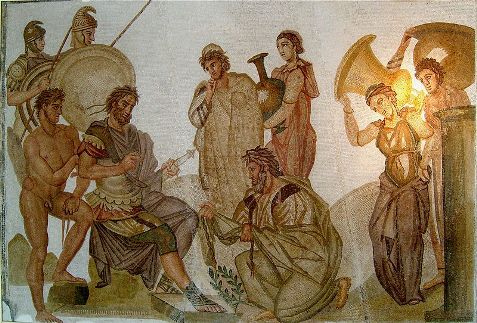
The Achaean society was patriarchal, the father can have as many concubines as he wants. The position of woman though is higher than Pericles' Athens as they are freely taking part in conversations and ceremonies. There is no education for girls who learn the house while boys are taught the art of hunting, war and farming. In peacetime, each family lives in their estate, at the periods of crisis there is a fortress leader, and the families are rallied around him. Power is exercised by the aristocracy with the king over all who has an army; his proceeds are from booty in times of war and from cultivating large areas belonging to the throne. Around -1194, according to most clues, the siege of Troy by the Achaeans began, which shocked the world of the time. Troy was a wealthy city on fertile ground and a strategic location, 9 cities, one on top of the other have been found, most of the destroyed by conquerors. Because of its prominent position at the entrance of the Hellespont, allowing it to demand imposts from passing ships, had always been the pinnacle of controversy.
Homer's Troy, which was destroyed by the Achaeans, was the 6th city built on the ruins of the past. The Achaeans wanted to conquer it to increase their power and for expanding to Asia Minor. The war evolved into a war of two worlds, as many kingdoms from mainland Greece sent an army to help Agamemnon and at the same time many Asian peoples sent troops to Troy. The Trojans spoke Greek according to Homer and had influences from Minoan Crete and from mainland Greece. The ten-year siege and ruthless war didn’t destroy only the defeated Trojans but also the winners Achaeans.
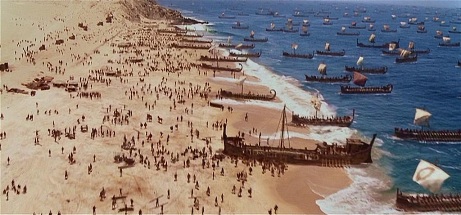
Several theories have been formulated about the collapse of the Achaeans and the Mycenaean civilization, such as the drought and the theory of social upheavals. Maybe were some drought times that had reduced the production combined with the uprisings of the lower classes such as slaves and farmers. Thucydides has written: "The long absence of the Greeks in Troy caused a great deal of turmoil, and revolutions in many states" while Plato had said that "during the ten-year siege of Troy things got worse in the homeland of each attacker. The younger people revolted and did not welcome the soldiers who returned to their place. There were countless murders, massacres and exiles". As a result, the victory over Troy was followed by dark ages for the Greek civilization. Back to the Story of Humankind