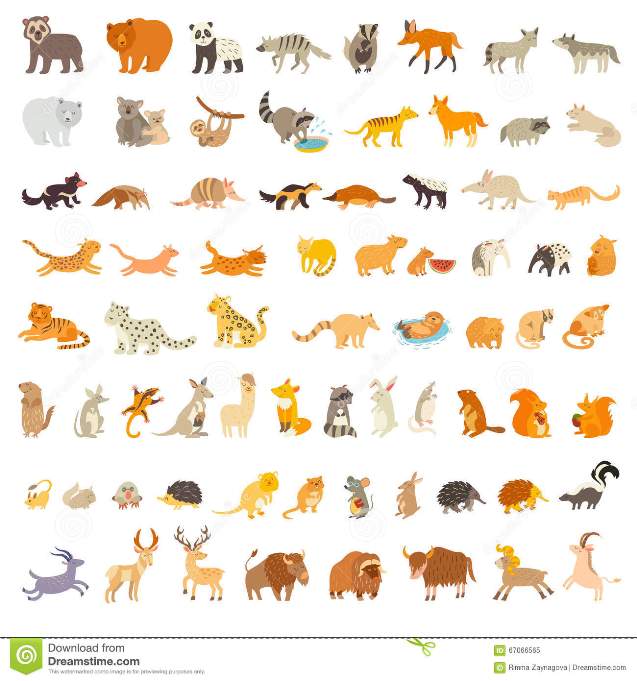
For about 170 million years, giant dinosaurs dominated terrestrial ecosystems, occupying most ecological niches. The early mammals of that era remained small and relatively inconspicuous, having adapted to a nocturnal lifestyle and hiding throughout the daytime.
When the dinosaurs disappeared about 66 million years ago, new evolutionary opportunities emerged. Small mammals rapidly spread and diversified into numerous forms.
The first mammals were usually about the size of small rodents. They possessed relatively large brains compared to their body size, more advanced jaws, and differentiated teeth adapted for different functions such as cutting and chewing food. Their bodies were covered with hair, and they possessed sweat and sebaceous glands.
One of the defining characteristics of these mammals was the feeding of newborns through milk-producing mammary glands. The earliest mammals probably laid eggs, as modern monotremes still do today.
Strange and transitional species appeared during that period. Lystrosaurus, although not a true mammal but a mammal-like reptile related to the ancestors of mammals, possessed a beak-like mouth and strong limbs. Other early mammal-like creatures lived in burrows and already displayed relatively advanced behavior.
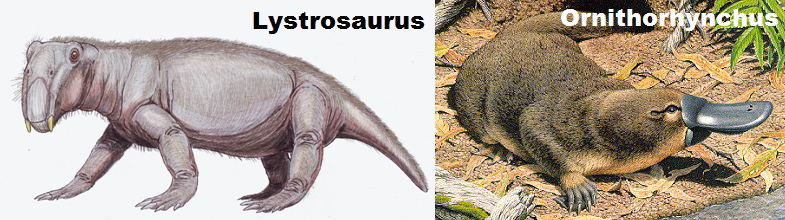
In geographically isolated Australia, primitive forms of mammals survived until the present day, such as the platypus and the echidna. These animals possess fur and nurse their young, yet they still lay eggs.
During evolution, embryonic development in some mammals became prolonged inside the mother’s body. Gradually, the placenta evolved — an organ that allowed nutrients and oxygen to pass from the mother to the embryo. This evolutionary development led to placental mammals, which gave birth to more developed offspring. The prolonged care of the young strengthened the emergence of complex social behaviors and close bonds between mother and offspring.
Today mammals are divided into three major groups:
Monotremes
The most primitive mammals. They lay eggs but nurse their young. This group includes the platypus and echidnas.
Marsupials
Their young are born at a very early stage of development and continue growing inside a special pouch. Examples include kangaroos and koalas.
Placental Mammals
The largest and most successful group of mammals. Their embryos develop inside the uterus with the help of a placenta.
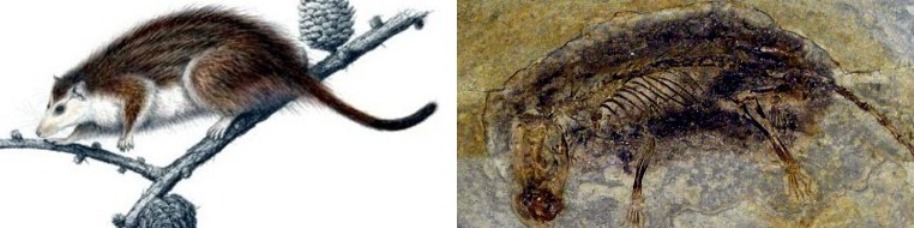
One of the earliest known placental mammals is Eomaia scansoria, a fossil approximately 125 million years old discovered in China.
The Evolution and Diversity of Mammals
After the extinction of the dinosaurs, mammals spread rapidly and evolved into thousands of different species. Many disappeared over millions of years, while others survive to this day.
The first known placental mammal (reconstruction and fossil approximately 125 million years old)
Among the most important groups of mammals are:
Anteaters, sloths, and armadillos,
Bats, the only mammals capable of true powered flight,
Carnivores such as cats, dogs, bears, and hyenas,
Cetaceans such as whales and dolphins, which returned to the sea,
Ungulates such as horses, deer, and rhinoceroses,
Proboscideans such as elephants,
and Primates, the group to which humans also belong.
PRIMATES