CLAY SIGN WITH REPRESENTATION OF MILITARY CROPS
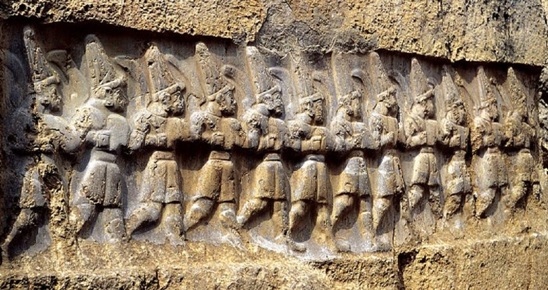
Their greatest power was held from -1450 to -1200, more than 10,000 clay tablets have been found from that period, in their capital, Hutus (in today's Turkey). Their language resembled Latin and Greek and their writing was from right to left the one line and from left to right the other. Some of the found inscriptions were dictionaries, one translated the same word in many different languages, as Babylonian, Sanskrit, Sumerian; other were administrative documents that reveal a monarchic military state. The Hittites disappeared around -1200 as mysteriously as they appeared; their culture disappeared.
North of the Hittite area were the Armenians who had maintained their customs, arts and independence for many centuries until the Persians conquered all of Western Asia. They had developed an advanced culture for the time and they had achieved a high degree of prosperity. They built large buildings, vases and statues of excellent quality and had close commercial relations with Greece, selling them iron.
Even further north, the Scythians, wild warriors of Mongolian and European descent who lived on their wagons, wandered on the shores of the Black Sea and invaded neighboring peoples. They were notorious for their cruelty, they drank the blood of their opponents to take their energy, and they could ride for many hours without saddles.
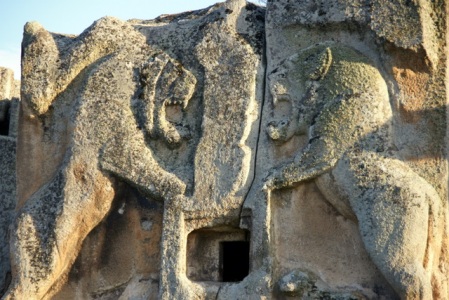
Another strong group emerging in Asia Minor was the Phrygians who were sailors from Thrace; they had reached Anatolia in around -1200 and had conquered the remains of the dissolute Hittites. They made Ankara their capital and at times had so much power to claim the rule of the Near East, from Assyria and Egypt. A farmer was their first king, according to their tradition, the one who contributed to their weakening was Midas around -600, with his absurdities and greed. From Phrygians is left the stunning stone constructions on rocks and caves.
PHRYGIAN STONE MONUMENT
The arrival in Asia Minor of a new group, the Lyds, ended the Phrygian hegemony. King Croesus around -550, with a series of successful wars, managed to spread their domination throughout Asia Minor, until the arrival of the Persians, who would wipe out the Lyds from the world map. Back to the Story of Humankind