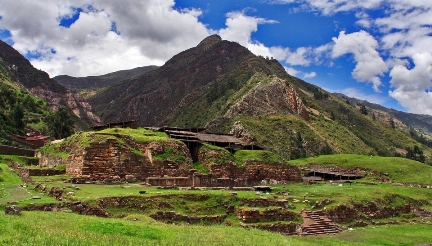
In the Andes of Peru from -2000 agrarian settlements were developed, in -1500 a tribe called Chavin, joined the scattered local settlements under a religious power and created an early civilization. Felines were significant forms for Chavin to which they had given religious significance and were reproduced in fabrics, sculptures, ceramics and stone statues found in Temples. Their culture suddenly collapsed around -400; we don't know the reasons.
In the region of todays Mexico, an indigenous people called Olmecs developed another pro-Colombus civilization since the early 12th century B.C. until the 3rd BC century. There is not much information about their origins or their language, and the name Olmecs was later attributed to them from a word of the Aztecs, meaning residents of the country of rubber. The oldest traces of this enigmatic civilization are placed on the Atlantic coasts of southern Mexico, at the site of the present-day state of Veracruz. Around -1250 a major religious center was created, San Lorenzo, which was completely destroyed after a rebellion of the lower classes, probably slaves, around -900. The form of their god is depicted with the feline jaguar and made sacrifices and ritual cannibalism.
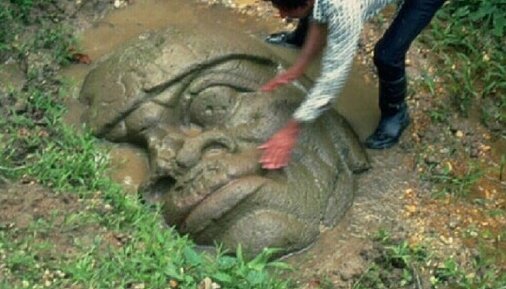
Their artistic creations include stone sculpted heads up to 3 meters high, full giant statues, altars and columns with hieroglyphics and calendars, sarcophagi, and objects in regular proportions such as masks, axes, various statuettes, jewelery, tools, etc. . In their inspiration there are animal figures (mainly jaguars and snake) or a hybrid combination of anthropomorphic jaguar, probably related to their religious beliefs. It is now thought that their culture has laid the religious, artistic and architectural foundations of the cultures that later developed in the region of Mexico and Central America. Olmecs experienced two uprisings that uprooted their civilization, suggesting strong class differences and great dissatisfaction from the lower classes. Back to the Story of Humankind