In a next phase of conquering activities, Sargon campaigned in the countries around the Persian Gulf and created a vast empire for the measures of that era, whose influence will reach Asia Minor and the Mediterranean. Along with the enormous territorial territory created by his conquests, Sargon was also the founder of a vast merchant empire with activities reached the ends of the known world, in India, Asia Minor, Caucasus, Ethiopia, but also in Crete.
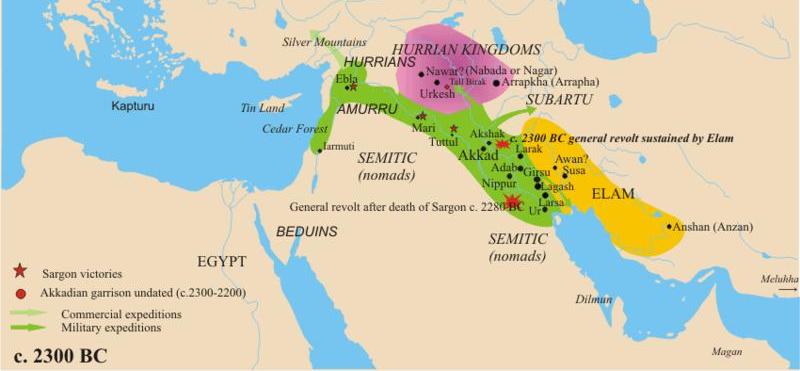
Sargon replaced the Sumerian language with a Semitic (of Akkad), cuneiform, and imposed a new administrative organization led by the city governors defined by the center. The Akkadians dominated not only politically to a large extent but also spread the Sumo-Akadian cuneiform script in almost all the Middle East countries, either with their conquests or with their commercial transactions resulting in becoming the official diplomatic language in West Asia for more than 1000 years. It is believed that the Babylonian and Assyrian language came from Akkadian.
THE NARAM-SHIN COLUMN SHOWING HIM ELIMINATING HIS ENEMIES
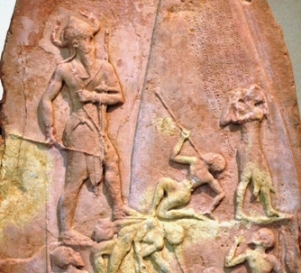
Sargon was succeeded by his sons, initially the younger Rimus, who faced a generalized revolt by the subordinate countries, who believed that the death of the great Sargon allowed them to regain their independence. Rimus was murdered by some courtiers and was succeeded by his eldest brother, who was also murdered after a palace conspiracy. After his murder, his son, Naram-Sin will rise to the throne, he is considered to be one of the great figures of the history of Mesopotamia, he extended the empire even further. On the reign of Naram-Shin there is also an ideological change, the deification of the living king. After that the empire fell into anarchy, the cities were revolting one after the other and the Akkadian empire collapsed around -2200.
The Sumerians were once again reigning in large areas of Mesopotamia, but they were not coherent and occasionally fell victim to premeditated attacks by old enemies. In around -2000 people form Elam attacked Ur, the most important city that time, broke its walls and burned it completely; they killed all those who did not need as slaves. Since then, the cities of Mesopotamia have fallen into a chaotic decline until Hammurabi's appearance in about 1800 b.C. Back to the Story of Humankind