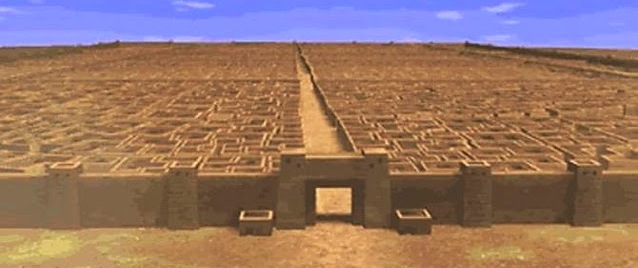
The houses were similar, they all had a bath, something completely innovative for the time, and the city had a genius sewer system. The absence of imposing or different dwellings shows that there was no social stratification or inequality, there was no king, aristocracy, slaves. Two stunning buildings have been discovered from the excavations at Mohendez Daoro, one being Grand Bath, a swimming pool to be used for ritual cleaning, and the second one a granary made of 27 huge brick blocks with well-studied vents to keep grain saved from goes bad.
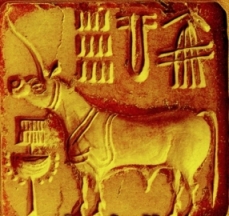
Excavations in the Indus Valley have brought to light a large number of stamps, probalbly used in business transactions. Some of them might have been religious, such as the one with a gold monokerus.
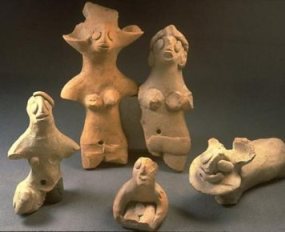
There have been too many statuettes, many to depict a woman who might have been a goddess-mother and others to portray bulls, which seemed to have both social and religious significance. Many anthropomorphic statuettes had side openings in which oil or aromatic oils might have burned. Tiny models of everyday objects, such as a carriage by bulls, were very popular in Mohsenzo Doro.
The inhabitants of the area were the first to cultivate cotton and also served in pottery and jewelery, developing flourishing trade. They had trade and religious relations with the Sumerians and probably with the Minoans. They worshiped the goddess mother and later various animals. They had a kind of script that has not been decrypted so we do not know much about their social organization, language, religion and customs.
What we know is that they did not have weapons or military training, prompting scientists to assume that the decline that began in 1800 BC and led to their eradication in 1500 BC was due to their peace-keeping organization, that a northern fighting tribe destroyed them with ease. After research over the last decades, it was concluded that it was the climate change that eliminated their culture and not an external enemy. The Indus River had contributed to the development of culture as agriculture was dependent on floods, they brought water to the fields and allowed them to grow wheat and barley, survive and prosper, build their cities, and evolve. The weakening of the monsoon and the drought began to hit the valley, the harvests began to diminish and destroy, the cities to suffer. They were slowly forced to leave their home. They moved westward to the valleys of Ganges and the Himalayas. These lands did not have the necessary extent, nor were so fertile to support their agricultural production and their crowded urban centers. Without crop surpluses, towns became smaller and smaller, resulting in small settlements. The inhabitants were dying of starvation, and those who survived were struggling to survive, children ceased to be born, culture was lost and remained unknown until 1924 when the first discoveries were made. Back to the Story of Humankind