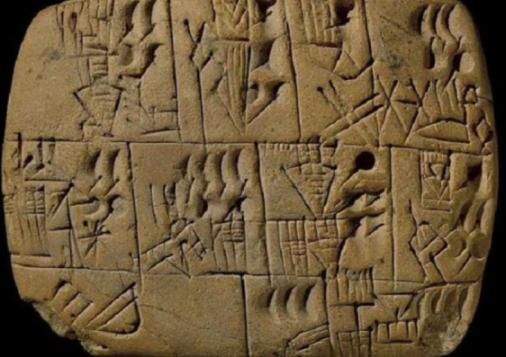
The first stage of it had to do with the recording of the grain in the common warehouse; they were grinding clay baskets to know how much each farmer had handed over and crossed it out when it was retrieved. Gradually, an early iconographic script was developed in which specific shapes represented concepts and things. A particular jug meant water, when it was designed vertically, it meant drinking.
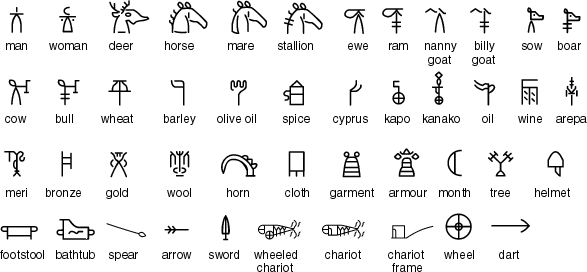
This Early Writing featured symbols for 1 , 10 , 60 , 600 , 3600 (a combination of decimal and hexadecimal arithmetic) and a series of patterns that were constantly increasing. It was originally partial writing, it could not represent the spoken language, it just stored useful information (mainly economic) on clay plates. Up to -2500 thousands of symbols had been added, transforming it into an almost total script that was called a wedge writing. At the same time, the Egyptians developed their own writing, which they called hieroglyphic because they used it by the priests, while the Minoans in Crete developed three different systems: the Cretan hieroglyph, the Phaistos disc and the linear A:
These early writing systems required much space and great effort to capture information, soon needed huge rooms filled with clay plates and it was extremely difficult to find information that had been recorded years ago. In addition, because of the constant addition of new symbols, the languages grew gigantic, and people could't remember the thousands of symbols. The solution came from Phoenicians, 1500 years after the appearance of writing; they thought of assigning a symbol to every well-known vocal sound. Real revolution. Instead of a different symbol for every concept, person, thing or object, with a small number of symbols suitably placed to each time, all the world can be reproduced. It is written that the alphabet was discovered in the Sinai mines by slaves who wanted to pass encrypted messages. However, the Phoenicians transmitted the new scripting system across the Mediterranean, the Greeks added vowels and gave the name alphabet from the first two letters alpha and beta. The alphabet was devised once only, all of the following alphabets and up to this day come from that original. Back to the Story of Humankind