The Babylonians put the captives in grounded areas, where there was to a certain extend a possibility of self-administration, a fact which helped them to get rights of acquisition. They also gave them other rights of political character which helped the preservation of the national identity. It was considered that this captivation fulfilled the prophecy for the punishment of Israel as people was in need of stronger dedication to God.
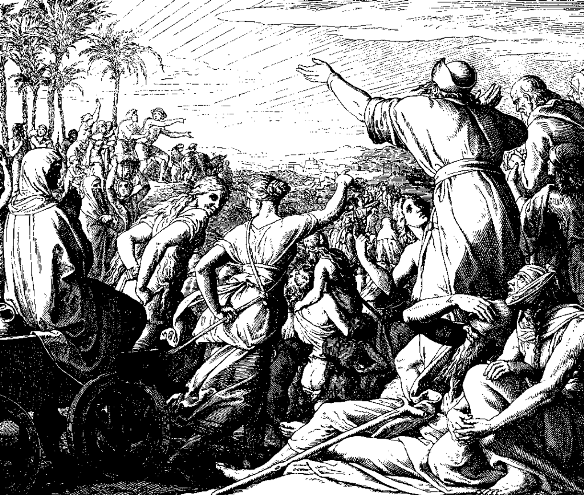
The Persian king Cyrus in 538 BC who had conquered the Babylonians, freed the captivated Jews and ordered them to return to their lands. All the sacred crockery of the temple were handed to the Jews who after their return they rebuilt the walls of Jerusalem, the city and the temple. After the Persian sovereignty, Judea became part of the Macedonian empire and after the death of Alexander the Great passed to his successors. Of which, Ptolemy II maintained a particularly favorable attitude towards the Jews and made sure that the authentic texts of their sacred books were translated into Greek. Within Jewish society, however, there was a difference between two groups, the isolationists and the non-isolatists. The isolationists around 250 B.C. created laws in order to ensure that Torah (Pentagram) was not to be violated. The legal aspect of Judaism that includes practices and applications covering everyday life, celebrations, fasting, purification ceremonies, and civil and criminal law, emerged that period, for first time.
In 63 BC the Romans invaded Jerusalem and the nation becomes a Roman possession and is joined into the area of Syria. The residents of Jerusalem were forced to pay a personal tax to the emperor while the roman army took over node points, but Jews also managed to preserve almost untouched their religion; they were acknowledged as a “special nation” inside the Roman Empire and their monotheistic religion was permitted and respected. Back to the Story of Humankind