Originally the city was under the supervision of Tyre, at the end of the 7th century BC it was autonomous from the rest of Phoenician cities and in 650 B.C. set up its first colony. In 600 B.C. was completely independent of Tyre which will be destroyed by the Babylonians later. Carthage on the other hand, gained power and gradually dominated the previous inhabitants, pushing some of them inland and capturing and enslaving the rests. The ground was fertile and the Carthage people created large estates in which the slaves worked giving them great profits. They discovered gold in central Africa and began to trade it, as well as tusks, continuously increasing their wealth and strength. They created an army and conquered the entire North African coastline, expanded to Spain, and then to the Balearic Islands, Malta, Corsica and pieces of Sicily. They were the first to issue paper money; it was leather strips with Carthage stamp.
CARTHAGE AT ITS BEST

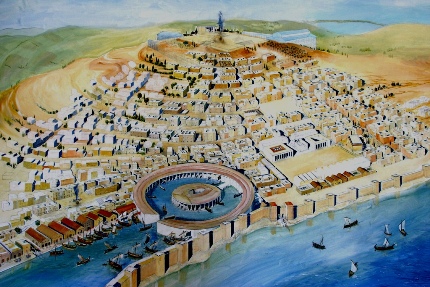
The city of Carthage reached 250,000 inhabitants and became famous for its brilliant temples, the public buildings decorated with Greek statues, the villas of the rich, the public baths and the safe harbor with 220 docks. In the center of the city there was a hill with a fortress, where the treasury was located.
REPRODUCTION OF ANCIENT CARTHAGE
Men and women in Carthage used to wear fancy dresses and jewelry, loved symposia and luxury, and are described by Greek and Roman writers as lecherous. However, their worst aspect, again based on the Greek and Roman writers, was their religion. Their ancestors at Phoenicia worshiped Baal-Moloch and Astarti, the Carthage people had similar gods but theirs was bloodthirsty. In times of crisis their priests claimed that only by sacrificing children would the Gods be exalted; there were days that up to 300 babies and young children were sacrificed. They placed them in the hand of a huge statue of the God, and as it was sloping, the small victims were flowing into the interior of the statue where it burned a great fire. The babies were burned alive under the sound of trumpets and drums, while parents were obliged to watch without showing distress as this would be considered disrespect for God. Some Greek writers believed that sacrifices were an attempt to control the over-fertility of humans.
The financial interests brought the Carthage in conflict with the Greeks of Italy and later with the Romans, in three wars. During the Second War, the Commander of Carthage in Spain, Annivas, crossed the Alps with a huge army and proceeded to Rome. He had a great victory in Cannes (216 BC) where more than 60,000 Roman soldiers were killed but over the next 13 years, he fought with the Romans without managing to reach to Rome. In the next war, (149 BC-146 BC), the Romans managed to conquer Carthage and they burned it completely, slaughtering more than 200,000 people and enslaving at least 50,000. A new Roman Carthage was built upon the defilements of the past, which flourished and later became a center of Christianity in Africa. In 553 it was incorporated into the Byzantine Empire and in 705 was finally destroyed by the Arabs. Back to the Story of Humankind