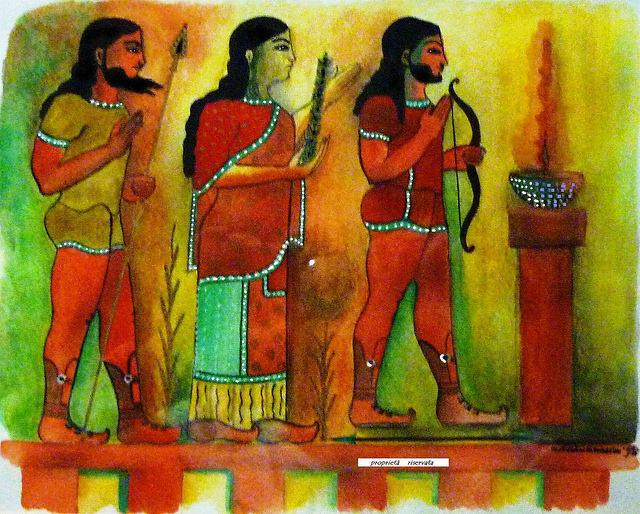
Their rule began as a monarchy and gradually became the oligarchy of powerful families of traders and craftsmen. As merchants expanded across the Mediterranean, from -500 they cut their own currency. They have stayed in history as famous and pioneering engineers as they have constructed desiccant canals for water drainage, opened roads between mountains and rocks and built geometrical cities with walls and stately imposing houses. Many elements of religion, art and their clothing betray influence from Asia Minor and Greece. They believed in many gods with the stronger to handling lightning and resembling Jupiter.
The Etruscans believed in predicting the future through the liver of lambs and the flight of birds. They also believed in the afterlife, they thought that the souls were going to a lower court where they could defend themselves for their living acts. If they did not convince the tribunal of their virtue, great torture was awaiting them. To avoid these tortures, enemies had to be sacrificed or slaves had to be buried with the dead so that they could also take part in the punishment. Their rituals always ended with a sacrifice, a sheep, a bull, or a man. And in every opportunity, they killed ceremonial prisoners of war hostages to rebuke the gods. In one case, they killed all prisoners of Phoecha with generalized public stoning, while in another, they killed 300 Romans in a central square as a sacrifice to the gods. One of their customs was the slave duel to death; many drawings have been found with such battles.
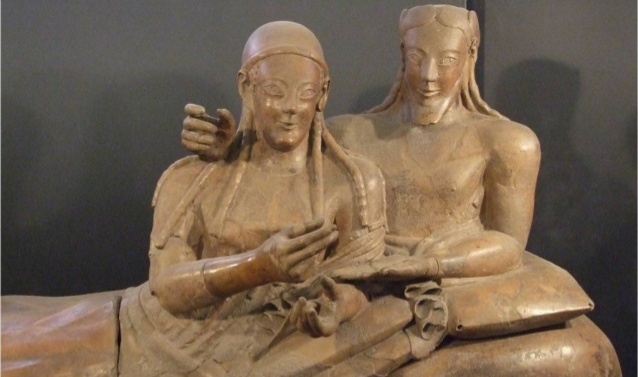
Their superior social classes lived with great luxury and they were buried in sarcophagi decorated with scenes of family peace or eagerness, with dancers having fun or with ladies of high social status to have glittering dresses and jewels, the same as those of the Minoans. The Etruscans gradually spread throughout central Italy, managed to dominate dozens of cities, including Rome for about 100 years. From Rome began their decline. First were defeated and expelled by the Romans, and shortly thereafter, at Kymi in 474, their navy was dismantled by the coalition of the Greek cities of Lower Italy. Gradually and other Italian cities rebelled against theme; in the 3rd century BC their grandiose civilization was finally eradicated and became the property of the upcoming Roman Empire. Back to the Story of Humankind