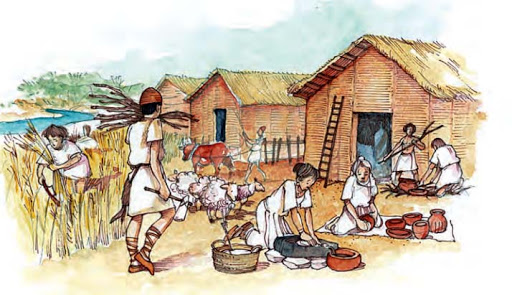
Another great discovery of this era was the birth of pottery through the processing of clay. Neolithic people mixed earth and water to create clay, a flexible material from which they made useful objects for their everyday needs. From the same idea came mud bricks — the first raw bricks — which were used in the construction of houses. Clay vessels were durable and significantly changed cooking methods, since they allowed water to be boiled and soups and stews to be prepared. At first, pottery was shaped simply by pressing the clay with the hands, but later, with the invention of the potter’s wheel, vessels acquired more symmetrical and refined forms. Gradually, pottery served not only practical purposes but also religious and artistic ones.
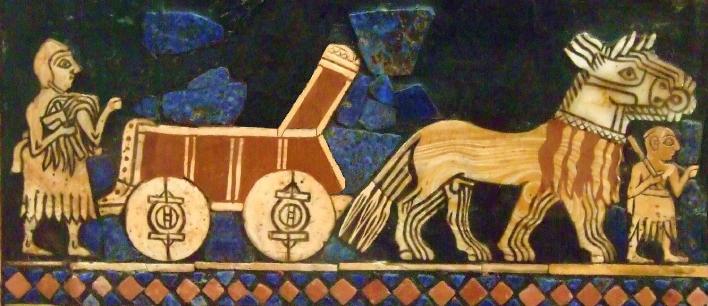
With permanent settlement in one place and the cultivation of the land, people began producing large quantities of food that had to be transported and stored. As they dragged heavy loads across the ground, they came face to face with friction. At first, they rolled their loads over tree trunks, a useful but extremely tiring method, since the trunks constantly had to be moved from the back to the front in order to keep the load moving. At some point, humans realized that the circular shape of the trunks could be used more effectively, and thus the idea of the wheel was born. The first wheels were simple and heavy, made of stone or solid wood and connected by an axle so they could roll more easily. Upon them were built carts and wagons, first pulled by humans and later by animals. Over the centuries, the wheel evolved, became lighter, wooden, and fitted with spokes, greatly facilitating transportation and trade.
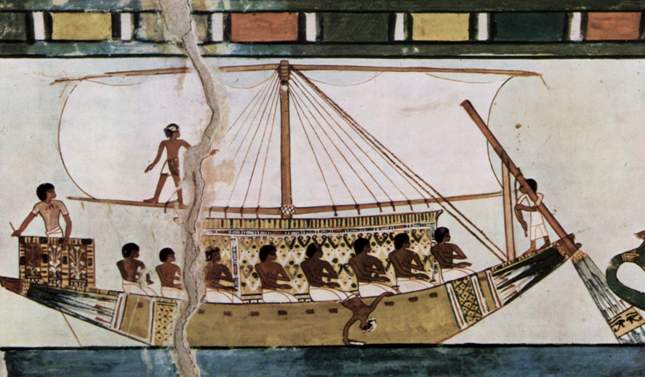
Human curiosity grew even stronger after all these discoveries, and soon people turned toward the sea. By tying tree trunks together, they built the first rafts, with which they traveled across rivers, lakes, and coastal waters. Over time, these rafts acquired better shapes and evolved into canoes, boats, and eventually ships capable of venturing into the open sea and transporting people and goods from one place to another. Thus were born the first sea voyages and the trade networks that connected distant civilizations. Back to the Story of Humankind