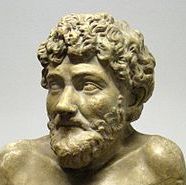
Biography
Aesop was a legendary ancient Greek fabulist traditionally placed in the sixth century BCE. His name became so closely associated with the short moral tale that hundreds of stories involving animals, people and everyday situations have been transmitted for centuries as "Aesop's Fables".
Very little about his life can be established with certainty. The earliest surviving references appear long after the period in which he is thought to have lived. Herodotus, writing in the fifth century BCE, describes Aesop as a slave associated with Iadmon of Samos and places his death at Delphi.
Later traditions greatly expanded his biography. They described him as a slave of exceptional intelligence who won his freedom through wit and wisdom, travelled widely and advised powerful rulers. Some stories connected him with King Croesus of Lydia and with the philosopher Xanthus. These episodes belong largely to the legendary tradition surrounding him rather than to securely documented history.
The surviving "Life of Aesop", composed many centuries later, presents him as an ingenious outsider who repeatedly defeats more powerful people through intelligence, storytelling and verbal skill. The work ends with his death at Delphi after a conflict with the people of the city.
The precise place of Aesop's birth is also uncertain. Ancient and later sources variously associated him with regions including Phrygia, Thrace and other parts of the eastern Mediterranean. For this reason no single birthplace can be regarded as historically certain.
Aesop himself did not leave a written collection of fables. Short animal tales and moral stories were already part of Greek oral and literary culture before his time, appearing in authors such as Hesiod and Archilochus. By the fifth and fourth centuries BCE, however, prose fables were increasingly attributed to Aesop.
Over time, many different stories from oral, Greek, Roman and later traditions were gathered under his name. Familiar examples include "The Tortoise and the Hare", "The Fox and the Grapes", "The Boy Who Cried Wolf", "The Lion and the Mouse" and "The Ant and the Grasshopper".
Whether every story attributed to him originated with Aesop is impossible to determine. His historical importance lies less in individual authorship than in the extraordinary tradition that formed around his name and made the fable one of the most enduring forms of moral storytelling.


