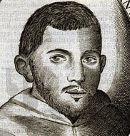
**Adriano Banchieri (1568–1634)** was an Italian composer, music theorist, organist, and poet of the late Renaissance and early Baroque. A prominent figure in the musical life of Bologna, he played an important role in the transition between the two periods, combining the polyphonic traditions of the Renaissance with the emerging expressive and theatrical language of the Baroque.
Banchieri was born in Bologna on September 3, 1568, and was baptized with the name Tommaso. In 1589, when he entered the Olivetan Benedictine order, he took the name Adriano. He studied music under the guidance of the Lucchese composer and organist Giuseppe Guami and developed a distinguished career as an organist in several monasteries. He served in Lucca, Siena, Bologna, Imola, Gubbio, Venice, and Verona before returning permanently to Bologna, where he became closely associated with the monastery of San Michele in Bosco.
In Bologna, Banchieri became not only a musician but also a teacher and organizer of musical life. In 1615, he founded the **Accademia dei Floridi**, an important musical academy that became one of the centers of musical activity in Bologna. The academy was later reorganized as the Accademia dei Filomusi under Girolamo Giacobbi. Banchieri remained active throughout his life as a composer, teacher, and intellectual figure.
Banchieri is particularly remembered for his madrigals and other vocal compositions, many of which display a remarkable sense of humor, theatricality, and vivid characterization. Among his best-known works are *La pazzia senile* (1598), *La prudenza giovenile* (1604), *La barca di Venetia per Padova* (1605), and *Il festino nella sera del Giovedì grasso* (1608). His music often moves beyond conventional madrigalian expression toward a more dramatic and theatrical conception of musical storytelling.
He was also an important composer for the organ and a prolific writer on music. His theoretical works, including *Cartella musicale* and *Conclusioni nel suono dell'organo*, provide valuable evidence of the musical practices, performance traditions, and compositional ideas of his time. His writings reveal a practical musician deeply interested in the relationship between musical theory and performance.
Banchieri's interests extended beyond music. Writing under the pseudonym **Camillo Scaliggeri della Fratta**, he produced comedies, rustic farces, literary works, and collections of stories and proverbs. He also wrote *Cacasenno*, published posthumously in 1641, continuing the popular literary tradition of Giulio Cesare Croce's *Bertoldo* and *Bertoldino*.
Banchieri died in Bologna in 1634 after suffering an apoplectic stroke. His legacy lies in the extraordinary breadth of his activity: he was simultaneously a composer, organist, theorist, teacher, poet, and organizer of musical culture. His work stands at a fascinating crossroads between Renaissance polyphony and the emerging Baroque spirit, while his theatrical madrigals reveal a distinctive combination of musical invention, humor, and dramatic imagination.