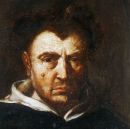
Tommaso Campanella (1568–1639) was an Italian philosopher, poet and writer. He was born on 5 September 1568 in Stilo, Calabria. He entered the Dominican order at a young age and became deeply influenced by the natural philosophy of Bernardino Telesio. His independent thought soon brought him into conflict with ecclesiastical authorities. In 1599 he became involved in a conspiracy against Spanish rule in Calabria. The conspiracy was discovered, and Campanella was arrested and imprisoned. He spent almost twenty-seven years in prison, where he continued to write philosophy, theology, politics and poetry. During his imprisonment he wrote his most famous work, The City of the Sun, a utopian vision of a society organized around knowledge, communal life, education and the common good. Released in 1626, he later moved to France, where he was received by Louis XIII and Cardinal Richelieu. He died in Paris on 21 May 1639.
Campanella lived during a period of profound intellectual, religious and political transformation in Europe. The Renaissance was giving way to the early modern world, while the Protestant Reformation and Catholic Counter-Reformation intensified conflicts over religion and authority. Southern Italy was under Spanish rule, and Calabria was marked by poverty, social tensions and political discontent. At the same time, traditional Aristotelian philosophy was being challenged by new approaches to nature and knowledge. Campanella was influenced by Bernardino Telesio and was part of this wider intellectual transformation that included figures such as Giordano Bruno and Galileo Galilei. His conflict with ecclesiastical authorities and his participation in the 1599 conspiracy against Spanish rule led to his imprisonment for almost twenty-seven years. His experience of political oppression, religious conflict and intellectual change shaped his vision of an ideal society in The City of the Sun, where education, science, communal life and the pursuit of the common good occupy a central place.