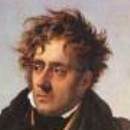
Biography
François-Auguste-René de Chateaubriand was a French writer, diplomat, and politician, and one of the pioneers of French Romanticism. He was born in Saint-Malo, Brittany, on September 4, 1768, the youngest of ten children. His father was a wealthy merchant who had acquired a considerable fortune and purchased the Château de Combourg, together with the title of count. Chateaubriand received an excellent education, developing a strong love of learning and a particular interest in the classical writers.
Because the family estate and title were inherited by the eldest son, Chateaubriand had to choose a career. From 1786 to 1790, he served in the army, although he had little enthusiasm for a military life. He did not participate in the early stages of the French Revolution and, in 1791, travelled to North America. He returned to France about eight months later, having spent much of his inheritance. He subsequently married Céleste de Chateaubriand, whose family was believed to be wealthy, although the marriage did not resolve his financial difficulties.
Chateaubriand joined the émigré army formed by aristocrats opposed to the Revolution and fought in defense of the monarchy. He was wounded in battle and, as the Reign of Terror intensified in France, fled to England. There he lived in difficult circumstances, supporting himself partly by teaching French.
During his years in England, he continued to write. In 1797 he published *Essay on Revolutions*, a work that attracted little attention at the time. He also experienced an unhappy love affair with Charlotte Ives, the daughter of an English clergyman. When she discovered that he was already married, the relationship ended. In 1800, following Napoleon Bonaparte's rise to power, Chateaubriand returned to France.
His literary career soon flourished. His novella *Atala* was published in 1801 and became an immediate success. In 1802 he published *The Genius of Christianity*, a major work that helped revive interest in Christianity and Catholicism in post-Revolutionary France.
Napoleon appointed him secretary to the French diplomatic mission to the Holy See. Chateaubriand resigned from the position in 1804, however, after becoming increasingly critical of Napoleon's policies and methods. In 1806 he embarked on an extensive journey through Greece, Asia Minor, Palestine, Egypt, and Spain. The journey inspired several important works of travel literature and profoundly influenced his writing.
Chateaubriand later published a fierce criticism of Napoleon, which contributed to his expulsion from Paris and established him as one of the most prominent voices of the royalist opposition. After the Bourbon Restoration, he entered government and briefly served as a minister, but his relations with the new regime were often difficult. He remained unwilling to compromise with political figures whom he regarded as remnants of the revolutionary era.
In 1818 he founded the newspaper *Le Conservateur*, which became an influential voice of the royalist movement. In 1822 he was appointed Minister of Foreign Affairs. His tenure was marked by disagreements with other members of the government, and he was dismissed in 1824. In 1825 he published *Memorandum on Greece*, strongly expressing his sympathy for the Greek struggle for independence and the Greek Revolution of 1821.
In 1828 he was appointed ambassador to Rome. Two years later, following the July Revolution of 1830 and the accession of Louis-Philippe, Chateaubriand withdrew permanently from political life. He refused to swear allegiance to the new king and devoted himself increasingly to literature and his memoirs.
For many years he had been writing his autobiography, *Memoirs from Beyond the Grave* (*Mémoires d'outre-tombe*). In 1836, facing serious financial difficulties, he agreed to sell the rights to the work to a publishing company, originally intending that it would be published only fifty years after his death.
His wife, Céleste, died in 1847. Chateaubriand died in Paris on July 4, 1848, at the age of 79. He was buried on the island of Grand Bé, near his birthplace of Saint-Malo, facing the sea.