Biography
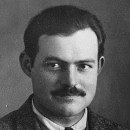
**Ernest Miller Hemingway** (July 21, 1899 – July 2, 1961) was one of the most influential American writers of the twentieth century, celebrated for both his fiction and his adventurous life. He was born in Oak Park, a suburb of Chicago, Illinois. His father, Clarence Edmonds Hemingway, was a physician, and Ernest was the second of six children. At the age of eighteen, he began working as a reporter for *The Kansas City Star*, where he developed the concise, direct prose style that would later become his hallmark.
During the First World War, Hemingway volunteered as an ambulance driver for the Red Cross in Italy. In 1918 he was seriously wounded on the Italian front and received Italian military decorations for his bravery. Returning to the United States in 1919, he married his first wife, Hadley Richardson, in 1921. The following year he covered the Greco-Turkish War as a foreign correspondent before leaving journalism to devote himself entirely to literature.
Hemingway settled in Paris, where he became one of the leading figures of the so-called **"Lost Generation"** of expatriate American writers and artists during the 1920s. His economical, vivid, and understated style revolutionized modern prose and influenced generations of writers. Among his best-known works are **The Sun Also Rises** (1926), **A Farewell to Arms** (1929), **For Whom the Bell Tolls** (1940), and **The Old Man and the Sea** (1952). The latter earned him the **Pulitzer Prize for Fiction** in 1953 and was a major factor in his receiving the **Nobel Prize in Literature** in 1954.
Outside literature, Hemingway was known for his love of adventure. He was passionate about big-game hunting, deep-sea fishing, bullfighting, and travel, and he reported on several wars as a correspondent. His eventful life and fearless personality became almost as legendary as his writing.
In the final years of his life, Hemingway struggled with severe physical illnesses and serious mental health problems, including depression and paranoia, which increasingly interfered with his ability to write. His condition was further complicated by heavy alcohol use. In late 1960 he voluntarily entered the Mayo Clinic, where he underwent electroconvulsive therapy in an attempt to relieve his symptoms. Although he was discharged in January 1961, his mental health continued to deteriorate. On **July 2, 1961**, at his home in Ketchum, Idaho, Ernest Hemingway died by suicide at the age of sixty-one. His memoir of Paris, **A Moveable Feast**, was published posthumously in 1964 and remains one of his most beloved works.