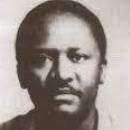
Biography
Okot p 'Bitek (1931 - 1982) was a poet, critic and anthropologist from Uganda; he is considered as one of the most important and original voices in 20th century poetry of East Africa.Okot P'Bitek was born in Gulu, Northern Uganda, on June 7, 1931 to a Luo family. Uganda was a protectorate of the British Empire at that time. His mother was a talented singer, songwriter and leader of the women of her tribe. Under the influence of his mother, P'Bitek grew up learning the stories, proverbs and songs of Acoli folklore. From a young age, P'Bitek himself became known as a dancer and drummer. He attended Gulu High School and King's College, Budo, where education was in accordance with the English school tradition for boys. Among other things, he emerged as a talented footballer and in 1965 he embarked on a tour in Britain with the Uganda national football team. When the matches were over, he decided to stay there to study. He received his bachelor's degree in education in Bristol and later studied law at the University of Wales and social anthropology in Oxford, where he completed his 1963 dissertation on the traditional songs of Acoli and Largo.
Returning to Uganda at the age of 33, he joined the staff of the Department of Sociology at the University of Kampala, and joined the artistic life of the city by founding dance groups and organizing cultural festivals. He was appointed director of the National Theater and the National Cultural Center in Kampala, while he also took part in performances as a singer and dancer.
He wrote his first poem in his adolescence, he gained international recognition with the epic poem "The Song of Lawino" in 1966, which he translated into English. The poem is the testimony of a wife whose husband forgets his roots and wants to live like the British. With his satirical monologues he introduced a new style that became known as "comic singing" and dealt with the conflict between European and African cultures. "Song of Lawino was followed by Song of Ocol (1970), to which Lawino's husband responds and presents his own version of the controversy.
In 1962, Uganda became an independent member of the Commonwealth with Obote as prime minister; P'Bitek criticized his rule, making himself unpopular in his home country do he monved to Kenya. He spent the following years of his life teaching in Kenya and the United States. Obote was overthrown in a military coup in 1971 by Indy Amin, and throughout his reign P'Bitek remained in self-exile.
In addition to poetry, P'Bitek published a novel, a collection of traditional Acoli songs, and a collection of Acoli fairy tales and short stories; he frequently contributed to magazines and newspapers, with articles and essays on anthropological, sociological, and philosophical topics. P.Bitek was married and had two daughters, he died in Kampala from a liver infection on July 19, 1982.


