Biography
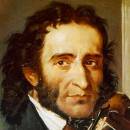
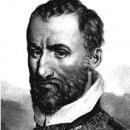
Giovanni Pierluigi da Palestrina, (February 1525 or 1526 - February 2, 1594) was an Italian Renaissance composer, one of the main representatives of polyphonic music who contributed significantly to the formation of Western church music. He was born in the town of Palestrina and around 1537 the director of the choir of Santa Maria Maggiore in Rome heard him extolling the products of the family farm in a stentorian voice and, impressed by his voice, undertook his musical education. Palestrina devoted himself to music and in 1544 he was hired as an organist in the church of Agios Agapitos in Palestrina. He soon married and began teaching and composing music. His musical performances attracted the attention and support of the local bishop, who later became Pope Julius III. Showing his gratitude, Palestrina later dedicated the First Book of Liturgies to him. In 1551 he left his post in Palestrina and returned to Rome, where he undertook the preparation of the children's choir of the Capella Giulia of the Vatican and later, at the urging of Pope Julius III, he became principal singer in the Sistine Chapel. The then cardinal and later Pope Marcellus II supported the young composer, and Palestrina rewarded him - after his death - with one of his most important works, the "Missa Papae Marcelli".In 1555 he was hired as the conductor of the choir of St. John Lateran and in 1561 he took up the same position at the temple of Santa with a better salary. In the context of the reforms and decrees of the Council of Trent (1545 -1563), Pope Pius IV assigned a committee of cardinals to improve the administration and formation of the Papal Choir. The "Liturgy of Pope Marcellus" was heard in the presence of the Pope in 1565, as a result of which the pope gave a guideline for the use of polyphonic music in the holy temples, resulting in its adoption by the church.
Pope Pius IV created for Palestrina the special position of "composer of the Papal Chapel" and increased his remuneration. In 1571 Palestrina occupied the position of chief musician of Agios Petros. Alongside his duties in preparing the Papal choir, Palestrina taught music and composed commissioned music for many Italian churches.
He died in Rome on February 2, 1594, leaving behind an enormous body of work, which is a benchmark in vocal counterpoint. Among other things, he composed 105 liturgies, 250 motets, 45 hymns, 33 megalynaria, 8 groups of "Lamentations", 9 compositions for church organ.