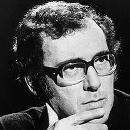
Biography
Harold Pinter was an English playwright, director and poet, as well as a political activist who frequently protested against what he regarded as American expansionist foreign policy and his own country’s participation in what he described as war crimes, including the interventions in Serbia, Afghanistan and Iraq.
He was born on 10 October 1930 in the East End of London, where he spent his childhood and youth. His father was a tailor of Jewish descent. Between the ages of nine and twelve, Pinter was forced to leave his home, like many other children, because of the Nazi bombing of London during the Second World War. At the age of eighteen, he refused to perform military service, declaring himself a conscientious objector.
He began writing poetry and became involved in the theatre, initially working as an actor. In 1948, he was admitted to the Royal Academy of Dramatic Art, but left after about a year and went on to tour with various theatre companies, performing in provincial theatres throughout Britain.
In 1956, he married and gave up touring. The following year, his play The Room was performed by students at the University of Bristol and attracted considerable attention. From then on, Harold Pinter wrote dozens of plays that were translated into many languages and performed in theatres throughout the world.
Among his most important works are The Birthday Party (1958), The Caretaker, The Homecoming, and Betrayal (1978). His plays are characterized by an economical style filled with pauses and silences, claustrophobic settings, unexpected appearances and unpredictable dialogue. His distinctive dramatic style became so influential that it gave rise to the adjective “Pinteresque”.
Pinter divorced his first wife in 1980 and married for a second time that same year. In 1996, he declined a knighthood, refusing to accept the honour from a Conservative government.
In 2005, Harold Pinter was awarded the Nobel Prize in Literature. His Nobel lecture had a strongly political character: alongside his reflections on art, language and truth, he sharply criticized United States foreign policy and the military interventions in Afghanistan and Iraq.
During the final decade of his life, Pinter returned increasingly to poetry while continuing his political activity. He also suffered from cancer and died on 24 December 2008, at the age of seventy-eight.