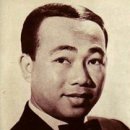
Sinn Sisamouth (probably 1933–1976) was a Cambodian singer, songwriter and composer who became one of the most influential figures of the country's golden age of popular music. Active from the 1950s until the Khmer Rouge takeover in 1975, he became known as the "King of Khmer Music" and helped create a distinctive Cambodian sound that combined traditional Khmer music with Western influences, including rhythm and blues and rock and roll.
He is believed to have been born on August 23, 1933, in Stung Treng Province in northeastern Cambodia, although sources give different years for his birth. When he was about seven or eight years old, his family moved to Battambang, where he developed an early interest in music and learned to play stringed instruments. At about sixteen, he moved to Phnom Penh to study medicine, partly to satisfy his parents' wishes, but his passion for music eventually led him to pursue a career as a singer and musician. He later worked as a nurse at Preah Ket Mealea Hospital while developing his musical career.
By the 1950s, Sisamouth was performing on Cambodia's National Radio and quickly became one of the country's most popular singers. His deep and expressive voice, poetic songwriting and remarkable productivity made him a central figure in the rapidly developing Cambodian popular-music scene. He wrote and recorded an enormous number of songs, ranging from traditional-style ballads and romantic songs to music influenced by contemporary Western pop and rock. He was also known for carrying his mandolin with him and using it while composing.
Sisamouth played an important role in the careers of several younger Cambodian singers, most notably Ros Serey Sothea. Sothea emerged as a major singer in Phnom Penh in the 1960s, and the two became one of the most celebrated musical partnerships of the era. Their numerous duets, particularly their romantic songs, remain among the best-known recordings of Cambodia's golden age of music.
His music also reflected the rapid cultural changes taking place in Cambodia. He adapted elements of Western popular music to Khmer lyrics and musical traditions, helping to create the unique Cambodian rock sound of the 1960s and early 1970s. His influence extended beyond singing and songwriting: he was also involved in film and directed the 1972 film *Jomreang Et Preang Thok* (*The Unfinished Song*), featuring Ros Serey Sothea.
In 1975, the Khmer Rouge seized power in Cambodia. Music and other forms of artistic expression were severely suppressed, while artists, intellectuals and other perceived enemies of the regime were persecuted. Sisamouth and his family left Phnom Penh, but he later returned after the Khmer Rouge called for musicians to help rebuild the country. He disappeared during the regime, and the exact circumstances and date of his death remain uncertain. Some accounts state that he was executed by the Khmer Rouge in 1976, but other accounts give different versions of what happened to him.
Sinn Sisamouth's music survived the destruction of the Khmer Rouge era and continued to influence generations of Cambodian musicians. Today he is remembered as the central figure of Cambodia's golden age of popular music and as one of the country's greatest singers and songwriters. His surviving recordings preserve not only his remarkable musical talent but also the sound of a vibrant cultural world that was almost destroyed by the Khmer Rouge.