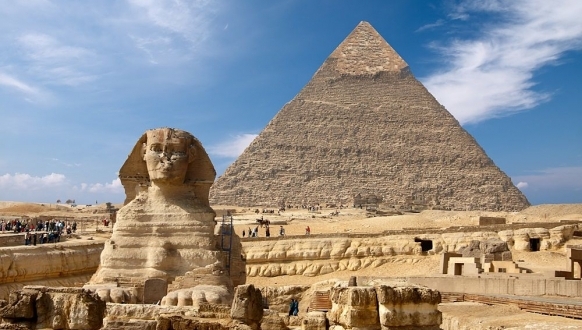
Cheops (Khufu), who reigned from -2589, demanded of the people to make a long road, transfer huge stones for many kilometers and build a majestic pyramid. Many thousands of people were killed in this work. And his successors continued to build pyramids and other majestic architectural masterpieces using people until their last breath.
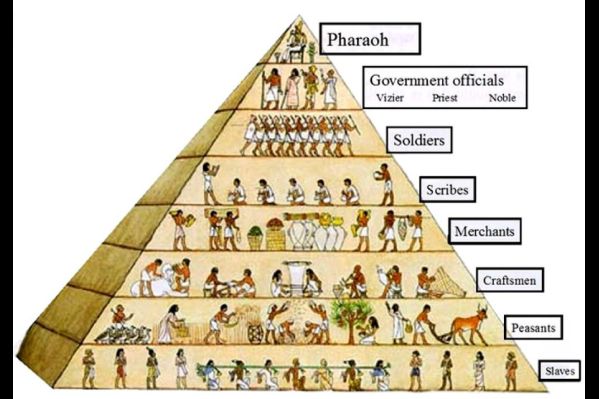
The pyramids were built because the Egyptians believed in the afterlife, and the Pharaohs wanted to have all the comforts in the other world. Together with the Pharaoh, many servants and food and precious objects were buried so that nothing was to be missed by them. The people suffered stoically following the voices of the priesthood, which had great power and supported Pharaoh. In return, the Pharaohs provided the priests with the spoils of wars and a great deal of taxes. On Ramses II, the priesthood had 110,000 slaves to whom he behaved inhumane, one seventh of the whole country's land and half a million large animals. It was great power that of religion throughout the history of ancient Egypt. Uranus, the Nile, the Moon was one of the most important deities, Osiris, Isis the Mount were other gods, and animals and plants were worshiped as gods as well. Society remained strictly class. In the high strata there were priests and nobles and scribes, while at the base there were free workers and farmers who paid taxes, indefinitely, and even below, slaves who worked to death without any reward. The people were in castes and usually the children of the workers followed the profession and the order of their father; it was difficult to go up. Schools existed only for the children of the upper classes, the priests taught in them.
In Egypt, the first postal service was developed, a large population of writers who recorded everything, from the animals that went to the slaughterhouse to the harvest of each farmer and the taxes and debts and the life of the upper class. With the help of the writing staff, the Pharaohs, the aristocracy and the priesthood ensured public order. It is surprising that people who have experienced so much oppression rarely revolted. Pharaohs to maintain the purity of their divine blood often married their sister or daughter while at the same time maintaining a harem, which some were taking with them when they died.

At the same time, slavish farmers and workers were dying of much work, the upper class of Egypt lived in luxury. They played a variety of games such as chess and dice, giving dolls, bows and other toys to their children, at the festivities they exchanged gifts, men and women were scented and dressed well with greased hair and body. The period from the reign of Cheops until -2100 is called the ancient kingdom and is the period when the pyramids of Giza and the great Sphinx were built and hieroglyphic writing were developed. Around -2100, a great drought, resulted to starvation and collapse of central government, and a turmoil of two centuries until 1900 BC. From that time the period of middle Kingdom begins with the presence of powerful pharaohs and the restoration of order. Back to the Story of Humankind