Around 70,000 years ago, one of the most important transformations in the history of the human species appears to have taken place. Scientists often refer to this period as the “Great Leap Forward,” since Homo sapiens began to display remarkable intellectual and cultural development. (Other scientists believe that this transformation occurred gradually over many thousands of years.)
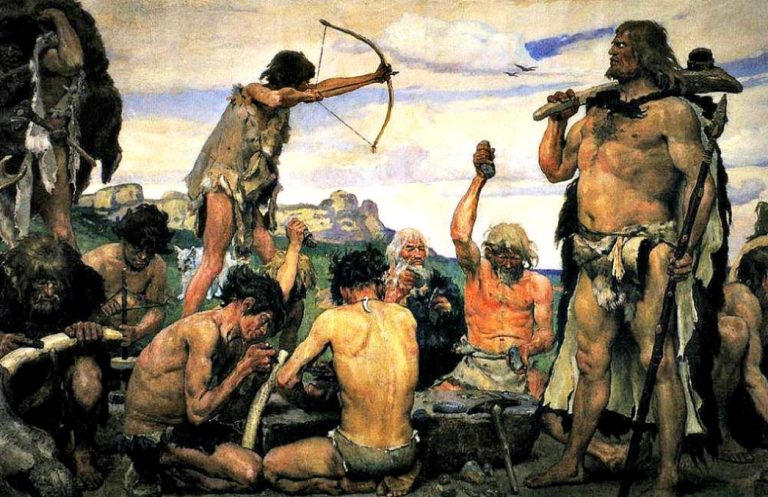
What is certain, however, is that the old crude stone tools were gradually replaced by more refined objects made not only from stone but also from bone, wood, and animal antlers. Humans learned to polish stone and create more effective tools and weapons: hammers, scrapers, spears, slings, and eventually the bow — a true superweapon of its age, which allowed people to kill even large animals safely from a distance.
In the following millennia, other great inventions would appear: the needle for making warm clothing, oil lamps that provided portable light, the wheel, and the first boats that enabled humans to cross rivers and seas.
This great transformation does not seem to have been connected to an increase in brain size. More likely, important neurological and genetic developments occurred, allowing new forms of thought, communication, and cooperation. Perhaps the neural connections of the brain became better organized, or the regions associated with language and imagination became more highly developed.
The development of speech also played a decisive role. Through language, humans no longer exchanged only immediate information about hunting or danger; they could now speak about things that were not physically present: the past, the future, dreams, fears, and hopes.
Thus were born the first myths, legends, gods, and supernatural forces. Collective imagination united humans more than ever before. For millions of years, the human species had been able to cooperate only in small groups of a few dozen individuals, where everyone knew each other personally. But once people began believing in shared myths, gods, ancestors, laws, and visions, they became capable of cooperating in far larger numbers.
Thanks to this new ability, tribes, peoples, kingdoms, and later empires emerged. Human societies were no longer organized solely around kinship, but around common ideas and shared narratives. This cognitive leap also triggered a vast geographical expansion. Modern humans gradually left their original homeland in East Africa and spread across the entire world. It was the second great migration of a human species out of Africa after Homo erectus — but this time humanity would go on to conquer almost every corner of the Earth. Back to the Story of Humankind