Biography
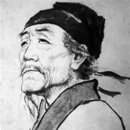
Du Fu (Chinese: 杜甫, 712–770) was a Chinese poet of the Tang Dynasty. Along with his contemporary and friend Li Bai (Li Po), he is considered one of the greatest Chinese poets. Everything we know about his life comes from his poems. His paternal grandfather was a well-known politician and poet, Du Fu was born in 712 in Henan Province, his mother died shortly after his birth and he was raised by his aunt first and later by his stepmother. He had an older brother, who died young. He also had three half-brothers and one half-sister, to whom he often refers in his poems. Their father was an official and offered him the formal education of their class, in order to prepare a future civil servant: a study of philosophy, history and poetry as well as memorization of Confucian classics. In the early 730s, he traveled to the Jiangsu area, his oldest surviving poem are from that time. In 735 he applied for a position in the administration but failed, and continued to travel this time around Shandong and Hebei. His father died around 740 and he could enter the administration due to the high position held by his father, but he relinquished the privilege in favor of one of his half-brothers who was in greater need.In the autumn of 744 he met Li Bai (Li Po) for the first time and they became friends. He was greatly influenced by him, who was already an accomplished poet. In 746, he moved to the capital, he married around 752, and by 757 the couple had had five children — three sons and two daughters — but one of the sons died in infancy. From 754 he began to have problems with his lungs (probably asthma), the first of a series of illnesses that would plague him for the rest of his life. The same year there was a great flood that destroyed the crops, followed by famine and subsequent riots and uprisings that lasted 8 years, during which Tu Fu wandered with his family in search of food. With difficulty and because of his acquaintances they managed to survive, however many of his compatriots died of starvation or as victims of war, the misery he experienced became a major theme of his poetry at that time.
In 756, Emperor Xuanzong was forced to leave the capital and resign, Tu Fu tried to enter the court of the new emperor but was captured by the rebels and taken to Changan. He escaped from Changan in 757 and in the following years he became involved in the political situation; others periods he was found in administrative positions with power, in other years he fell into disfavor, and went so far as to write to friends and beg for financial help.
In the autumn of 766, a friend of his became governor of the region: he financially supported Du Fu and hired him as an unofficial secretary. In the spring of 768, Du Fu and his family sailed to the Yangtze River to travel to Luoyang, the area of his birthplace, which had been recaptured by government forces. Tu Fu died during the voyage in 770, exhausted from many health problems. He is considered the first person in the world to be recognized as a diabetic patient while he also suffered from pulmonary tuberculosis.
He was not very famous while in his own itmes, but in the centuries following his death, his works - some fifteen hundred poems have survived - had a profound influence on both Chinese and Japanese literary culture. Critics who have studied his work have called him a "poet-historian" and a "poet-sage".


