Until the Agricultural Revolution, many small groups of hunters and gatherers appear to have lived with greater equality between men and women than later societies. Men hunted and supplied the group with meat, while women gathered fruits, roots, and herbs, cared for the children, and possessed a deeper understanding of nature’s cycles. In several early societies, kinship was recognized mainly through the mother, and children were more closely connected to the maternal line of the family.
The great transformation came with the Agricultural Revolution, around ten thousand years ago. Many researchers believe that women, because of their daily contact with fruits and seeds, may have played a decisive role in the discovery of cultivation and in the need for permanent settlement. Men and women together ground grains, kneaded and baked bread, domesticated animals, used wool and cotton to produce thread and textiles, wove baskets from straw and plant fibers, made ropes, nets, and traps, and shaped clay into vessels for storing food and liquids. The foundations for permanent settlements and organized societies had now been established.
Yet this new era also brought profound social changes. People who had once moved constantly and possessed very little began to claim land, herds, and food supplies as property. Along with ownership gradually came the need to control inheritance. As a result, paternity gained greater importance, and society increasingly came to be organized around male authority.
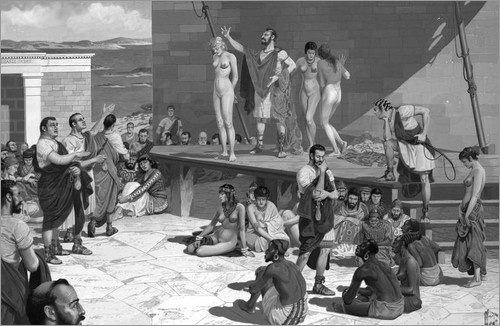
SLAVE MARKET RECONSTRUCTION
This transformation was also reflected in religion. In many early societies, female deities associated with fertility, nature, and Mother Earth were dominant. Later, powerful male gods emerged — symbols of authority, war, and domination — reflecting the rise of the new patriarchal order.
For thousands of years, women had to struggle to regain rights and an equal place within society — a struggle that, in many parts of the world, continues even today. Back to the Story of Humankind